
Why Broad Targeting Isn't The Silver Bullet To Advertising On Paid Social
.png)

As media buyers, we must ask ourselves: Are we falling for “best practice bias?” Are we limiting ourselves from trying new things simply because they aren’t the hot topic of the day or being actively promoted by Meta?
Many people in paid social advertising question the impact of audience targeting in 2024. We’re here to tell you to ignore the noise. Test for yourself.
With marketing gurus on DTC Twitter pounding their fists on the table, saying just go broad or Advantage + Shopping Campaigns (ASC) is the only way forward, it can seem daunting to try and go against the grain. But just because audience targeting isn’t the flavor of the month (or the year, for that matter) doesn’t mean you shouldn’t test to find out for yourself.
In today’s highly competitive advertising landscape, pouring your entire budget into any one strategy is not advisable, even if that strategy is being promoted heavily by Meta. To ensure you’re getting the maximum value from every ad dollar you spend, it’s crucial to test each tool that Meta places at your disposal, including audience targeting.
In this article, we’ll cover 4 audience types you can test today that will help bolster ad performance beyond what Broad/ASC can deliver on their own.
4 audience types every brand should consider
While audience targeting can look a bit different for each brand, we’ve compiled four foundational paths that companies of any size and vertical can use effectively. Here’s our take on how to make each one work for you.
1) Interest-based audiences
Interest-based audiences are all about connecting with users whose interests align with your brand. We think about interest-based audiences in two categories:
- Directly Related Interests: If you’re a beauty brand, you might target a group of users on the basis of their interest in various beauty-related things, whether that’s haircare, skincare, or even certain brands or influencers.
- Tangentially Related Interests: Audiences built around a looser and more subjective set of common interests. If your brand’s target demo is affluent women in their early 30s, you might build an audience around interests like Lululemon, Alo, Peloton, SoulCycle, Whole Foods, Sweetgreen, Taylor Swift, the Hamptons. The idea here is to make tertiary brand and lifestyle connections.
Leveraging your knowledge of customer lifestyle habits and tertiary interests can uncover powerful new segments that expand your reach.
Don’t overthink how many interests to include in your stack. Just pick as many as you find relevant. We usually look for a mix of 5 to 15.
Once we assemble the interests, here’s our common campaign setup:
- 3-5 ad set CBO (# of ad sets to test depending on budget / avg CPA)
- Each ad set represents a category of interests (e.g., beauty, health, cooking, fitness)
- Enough budget in the CBO to get 7 purchases/day per ad set (7 x L30 CPA x Number of Ad Sets)
- Top 5-7 Post IDs from the account in the last 14 days
Let’s assume that you’re a women’s skincare brand and have a $50 CPA. Here’s a test you can implement in your account right now:
Budget: $1,050
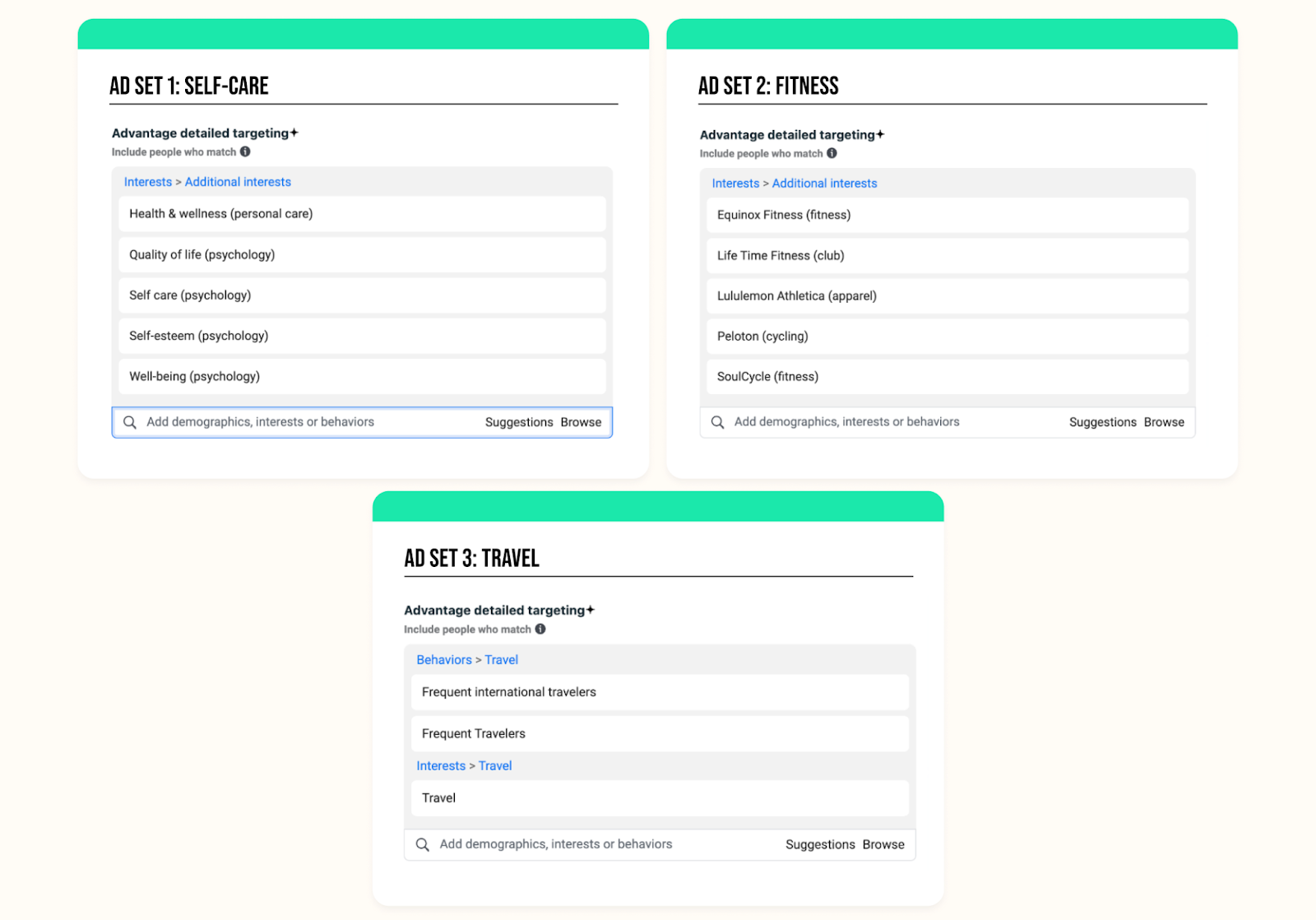
- Ad Set 1 (Self-Care): Health & wellness, Quality of life, Self-care, Self-esteem, and Well-being.
- Ad Set 2 (Fitness): Equinox, Life Time Fitness, Lululemon, Peloton, and SoulCycle.
- Ad Set 3 (Travel): Frequent international travelers, Frequent travelers, and Travel.
2) Lookalike audiences
Lookalike (LAL or…LLA 😈) audiences let you target new users who closely mirror your existing customers in purchasing behavior, demographics, and interests. LALs have two basic elements:
- The seed
- LAL percentage
By providing Meta with large, high-quality seeds, you can give the algorithm a stronger signal to build lookalikes that convert (Give the car gas!).
There are many different audience seeds you can test, including…
Dynamic seeds (based on a set of parameters you provide and will update in real time):
- Pixel-based (creates a LAL of people similar to ALL of your customers)
- Value-based (creates a LAL of people most similar to your highest-value customers by leveraging LTV data — you can create these in your audience library)
- Shops engagers, purchasers
- Klaviyo segments (via integration)
- Facebook/Instagram engagers
- Video viewers (which you can break out into different durations or percentages of watch times)
- Shopify Audiences
- Proxima AI Audiences (data-enriched seeds)
Static seeds (based on a non-changeable list export):
- Shopify list exports
💡 Tip: Get creative with your Shopify exports. For example, if you’re trying to go after high-value shoppers, you can export a list of customers who purchased with an Amex. You can also segment by AOV, LTV, or purchase frequency.
Once your seed data is uploaded, it’s time to select a lookalike percentage to fine-tune how closely your new audience should align with your seed. The smaller your percentage, the more similar your LAL will be to the seed audience. You can experiment with this percentage to nail the right number.
For larger accounts with a lot of spend, 10% LALs are usually going to work best because you’ve likely exhausted the 1% LALs (1% can be tested in larger accounts but might not be as effective as 10%).
Here’s how we structure our LAL tests:
- 3-5 ad set CBO (# of ad sets to test depends on budget / avg CPA)
- Each ad set represents a category of LAL seed (e.g., pixel, value, social, Klaviyo, etc.)
- Stack LALs inside
- Enough budget in the CBO to get 7 purchases/day per ad set (7 x L30 CPA x Number of Ad Sets)
- Top 5-7 Post IDs from the account in the last 14 days
Let’s assume you have an average CPA of $50. Here’s a test you can implement in your account right now:
Budget: $1,750
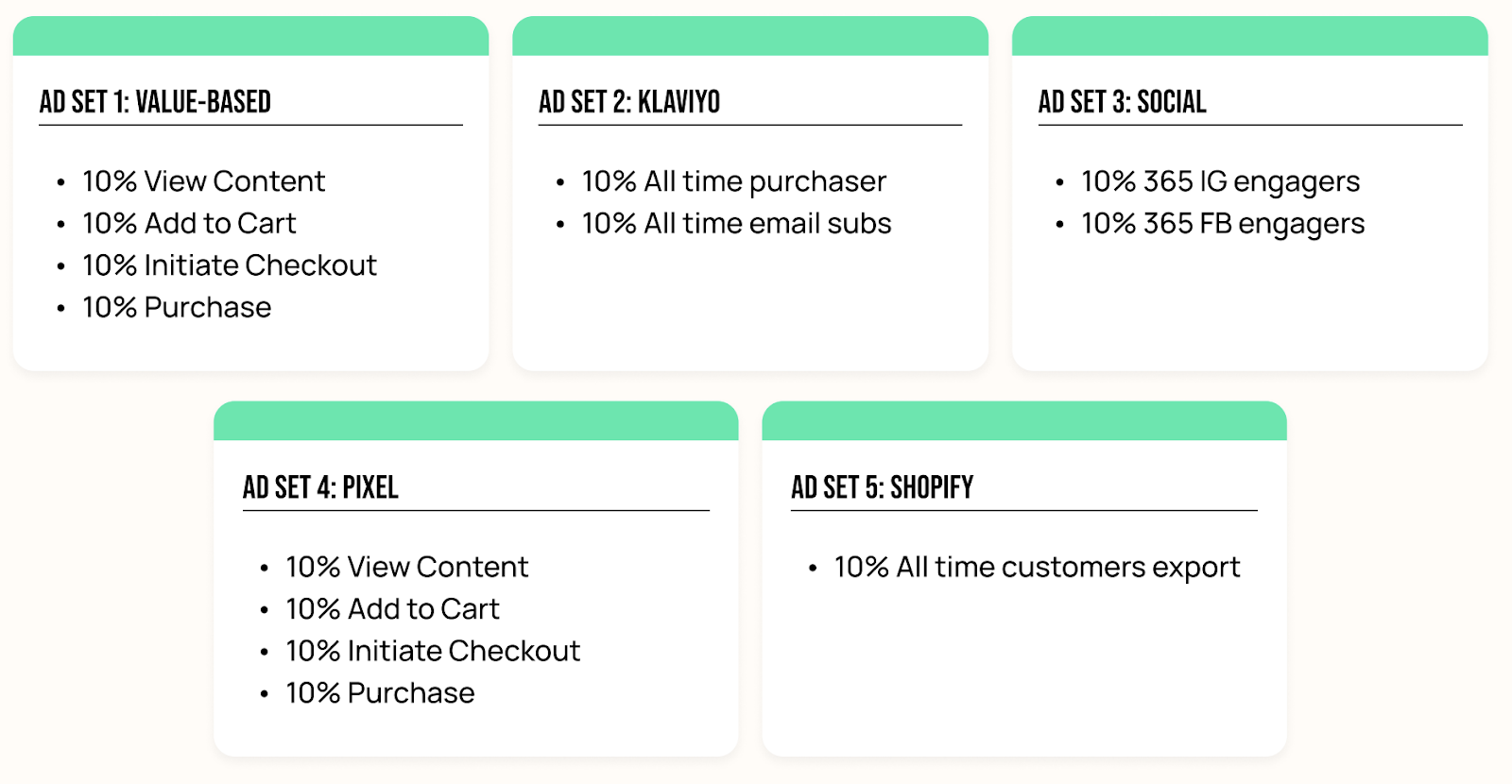
- Ad Set 1: Value-Based
- 10% View Content
- 10% Add to Cart
- 10% Initiate Checkout
- 10% Purchase
- Ad Set 2: Klaviyo
- 10% All time purchaser
- 10% All time email subs
- Ad Set 3: Social
- 10% 365 IG Engagers
- 10% 365 FB Engagers
- Ad Set 4: Pixel
- 10% View content
- 10% Add to cart
- 10% Initiate checkout
- 10% Purchase
- Ad Set 5: Shopify
- 10% All-time customers export
3) Proxima AI Audiences
If you’re looking to really scale things up, Proxima unlocks a whole host of new LALs by leveraging billions of cross-store data points.
If traditional seeds are like gas for the car, Proxima gives you rocket fuel.
With their data intelligence platform, you can easily build data-enriched LALs that open up new audience pools and send higher-quality signals back to Meta, so you can be more aggressive on customer acquisition without sacrificing profitability.
Their AI Audiences are algorithmically generated LALs that match a brand’s ideal customers based on deep insights from analyzing your brand’s first-party data and their extensive network of cross-store Shopify data.
Proxima achieves this using its vast Shopper Universe of cross-store data — 80M+ shoppers and $20B+ in purchases across thousands of Shopify stores — to effortlessly generate data-enriched audiences that lay the foundation of your targeting strategy.
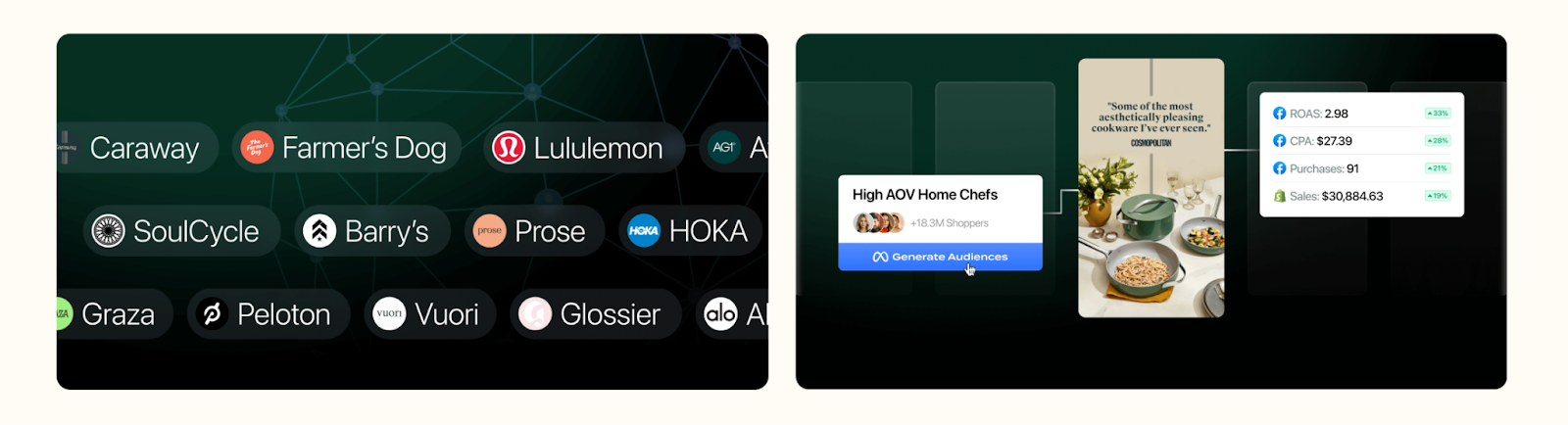
By analyzing cross-store purchase behaviors (e.g., where people shop, what SKUs they buy, AOV, purchase frequency, LTV) and sending high-quality pixel events back into Meta, Proxima’s algorithm constructs predictive audiences that enrich Meta’s signal so you can scale your ad spend more efficiently.
But don’t just take our word for it. Ask leading pest control startup Pestie, who added $6 million in incremental ad spend while maintaining efficiency and CAC with Proxima. The Pestie team has since seen an 86.9% increase in daily new orders, and some of their original AI Audiences are still running today (2+ years in), spending as high as $30k/day with no signs of efficiency decay.
“Many in paid advertising question the future of audience targeting, but Proxima’s AI has turned that notion on its head with game-changing results.” — Tanner Duncan, General Manager at Herrmann Digital
4) Retargeting audiences
While retargeting doesn’t work as well as it once did, it can still be a revenue driver. Retargeting remains a viable method for reconnecting with users who’ve already shown interest—whether they browsed your site, engaged with your emails, or previously purchased.
We no longer over-segment our retargeting. Instead, we group audiences by time windows.
Here’s our preferred setup:
- Long Window: Anyone who has interacted with you in the past year. Keep in mind that pixel data only goes back 180 days. Here’s a stack of audiences we suggest testing:
- L365 social (FB/IG, Profile and Shop engagers)
- L365 Klaviyo (Active/Engaged subscribers who’ve been on-site or opened/clicked email in the last X days, Purchasers, etc.)
- L180 pixel (Site Visitors, View Content, Add to Cart, Initiate Checkout, Purchase)
- Recent Window: Anyone who has interacted with you in the past 30 days. Here’s a stack we suggest testing:
- L30 social (FB/IG, Profile and Shop engagers)
- L30 Klaviyo (Active/Engaged subscribers, Purchasers, etc.)
- L30 pixel (Site Visitors, View Content, Add to Cart, Initiate Checkout, Purchase)
You are more likely to find success with larger audiences, which gives the algorithm more room to optimize. However, if you find something that’s working well, you can break out the audience stack into smaller segments to test further. For example, if L365 is working and you want to see how Klaviyo does, break that into its own ad set to test further.
In summary, there are meaningful pockets of scale and efficiency to unlock beyond broad.
Whether using traditional methods or data-enriched tools like Proxima, we encourage you to explore audiences as a lever for scaling up your top ads outside of broad.
Think of audiences as adding gas to the fire.
And, start experimenting with them now to find what works best for you, fuel growth, and set your brand up for success.
Supercharge your audience targeting with Proxima
With Proxima’s data intelligence platform, leading DTC brands are achieving unprecedented advertising efficiency and scale.
Take the luxury floral brand Venus et Fleur as an example. As their largest sales event of the year (Mother’s Day) quickly approached, they needed to navigate Meta’s ballooning CPAs.
Within 24 hours of onboarding, Proxima provided Venus et Fleur with boosted seed audiences of users whose shopping behaviors mimicked the brand’s top customers. These behaviors included the stores they frequently purchase from, average order value, and even details like which flowers and vases each customer purchases.
With Proxima at the helm of its paid advertising strategy, Venus et Fleur scaled Meta ad spend by +31% while improving NC-ROAS by +13%. And the performance improvements weren’t limited to Meta. On TikTok, where results had previously been a bit stagnant, Proxima’s audiences drove a +73% increase in efficient ad spend.
The icing on the cake? Proxima’s granular audience insights empowered Venus et Fleur to craft SKU-specific creative, unlocking a more personalized and profitable ad strategy.
Ready to target high-converting audiences without the guesswork?
See why industry experts and high-growth brands alike look to Proxima to drive profitable marketing on paid social.
Recent posts

Ready to break through your performance ceiling?
Connect your data and see for yourself.