
April 2024 Meta Trends Report

Proxima's Meta Trends Report for April 2024
Volatility in the Meta advertising ecosystem can be highly concerning, especially for brands who rely on the platform to fuel their growth.
Media buyers looking to get their bearings often consult DTC Twitter or private group chats to see how their peers are holding up. One-to-one benchmarking is a useful tactic, but we wanted to do more. So, we took a look at aggregated data across a subset of Proxima customers to help guide your Meta strategy in the coming months.
Our team tracked over $43.3M in Meta ad spend in April 2024. Here are the key takeaways we uncovered.
April 2024: Meta Performance experiences a minor dip
To form this dataset, we analyzed a subset of ~200 Proxima customer accounts (brands over $1M GMV). These eCommerce brands operate across various categories, including fashion, beauty, health and wellness, pet care, food and beverage, and more.
Here’s what we found:

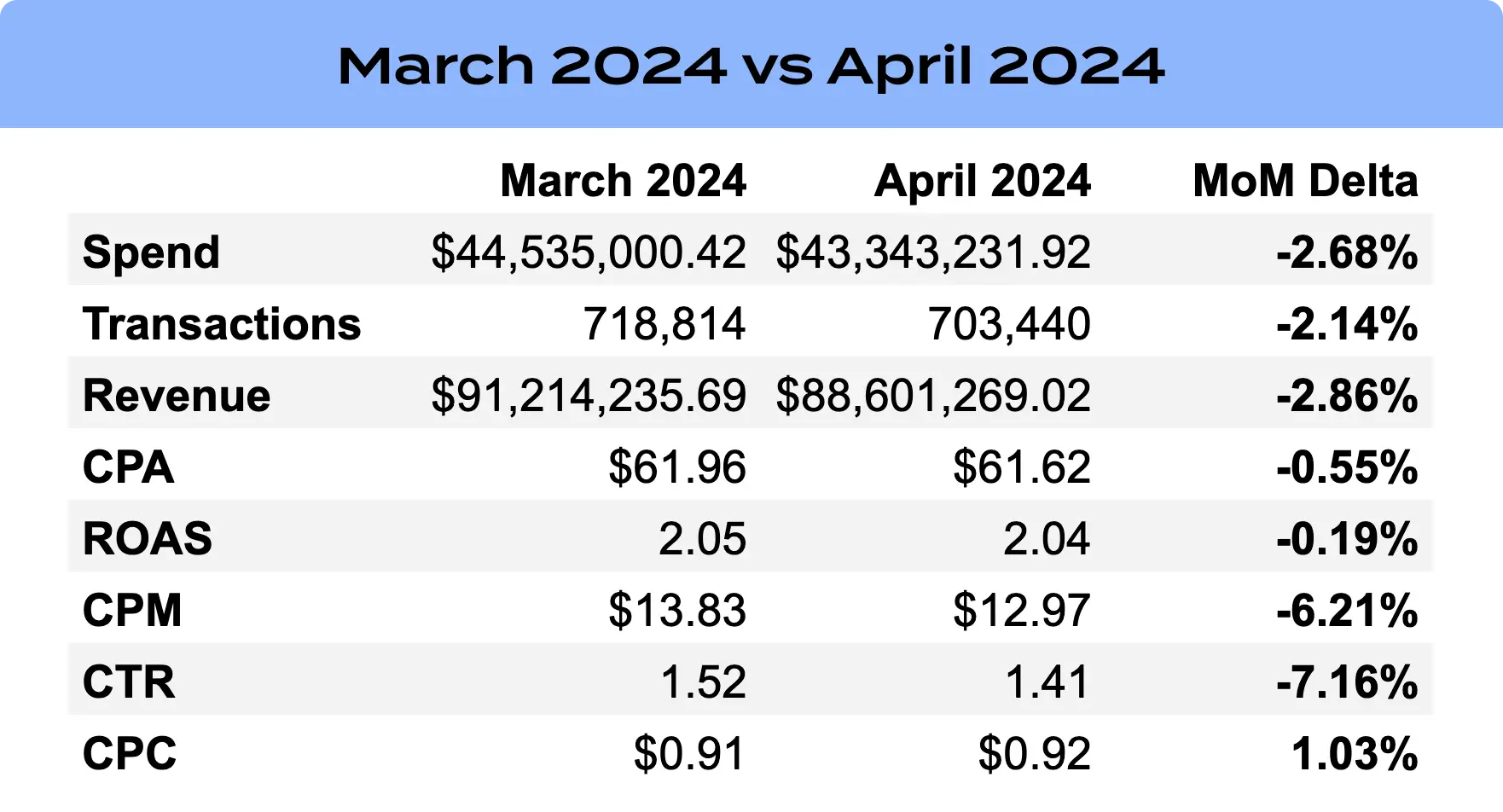
A shaky March led to reduced spend in April
If you’re a frequent flier on DTC Twitter, you already know Meta ad performance saw significant turbulence in March, with brands across all categories reporting double-digit drops. As a result of this volatility, Meta spend decreased MoM (-2.68%), as advertisers likely reallocated budget to other platforms like TikTok and Google. Lower-funnel metrics (such as acquisition costs and revenue) all declined by similar percentages as a result of pulling back spend.
YoY Meta performance remains strong
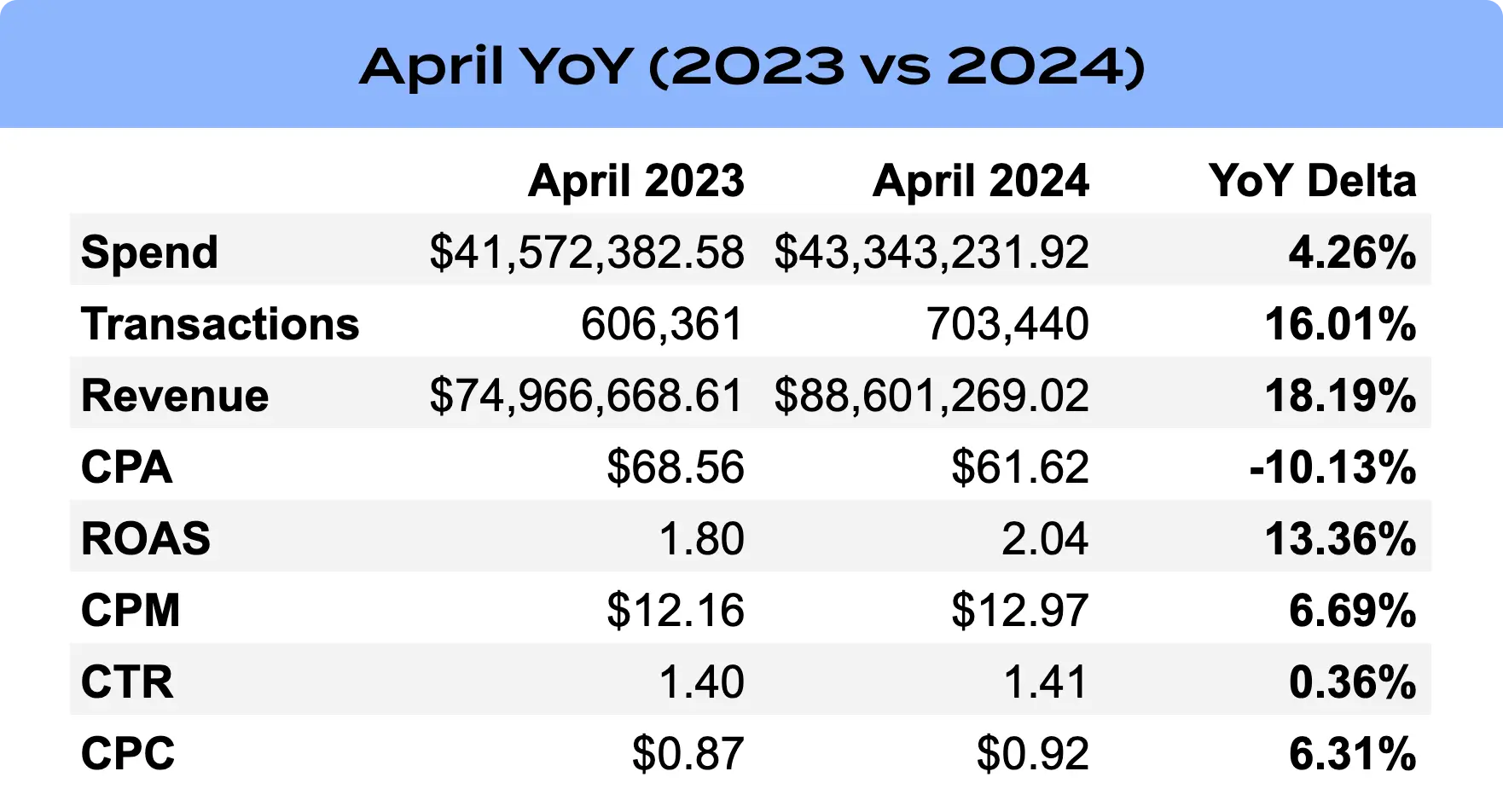
Despite a turbulent start to the year, brands saw strong YoY results from their paid marketing efforts on Meta. When compared to April 2023, we’re seeing positive trends across the board:
- Ad spend: +4.26%
- Transactions: +16.01%
- Revenue: +18.19%
- ROAS: +13.36%
- CPA: -10.13%
At the top of the funnel, CPM (+6.69%) and CPC (+6.31%) were slightly more expensive than 2023. However, when we zoom in, April 2024 generated stronger Day-over-Day stability in comparison to the previous year, resulting in more stable delivery periods, likely aiding the increase in efficiency YoY.
Some advice to help you weather the storm
It's true that Meta performance has been volatile this year, and competition is fiercer than ever. But, your brand can still retain efficiencies on the platform even during downtimes. From de-risking your targeting to reducing reliance on ASC to testing new creatives, our team has a few tips for extracting more value from Meta during turbulent periods.
Don’t lose confidence in Meta
For many brands, volatility in the Meta ecosystem can be extremely destabilizing, especially when it makes up the majority of your channel mix. But the best course of action is to take a beat, breathe, and zoom out. As we saw from YoY data across Proxima customers, ad performance on Meta has improved overall. Meta has consistently been the most prominent social platform in the world, which is why it remains nearly every high-growth brand’s go-to. Even when numbers get a bit rocky, Meta is still your best bet.
Lean into creative iteration
Most people will tell you the only way to improve performance on Meta is to constantly test new creatives. After all, that is how you stand out in the auction system and “target” within Meta’s new world order of ASC and going broad. Creative iteration is a powerful lever that can improve performance and nudge the algorithm in the right direction. But, analyzing creatives across all your ads can be an expensive, time-consuming process that is not doable for everyone.
Our comprehensive Meta advertising guide can walk you through the key steps of creative testing.
Diversify your budget distribution within Meta
Resist the urge to focus your ad spend on a single strategy. While Meta often suggests you allocate most of your budget to ASC, it’s a black box. To put it simply, you’re handing the keys to Meta and letting the algorithm do the work.
Sounds enticing, but the fact is, you’re giving up control and creating concentration risk by putting too much of your budget in a single place. When the algorithm goes sideways (which we’ve seen several times already this year), or there’s a bug, or they push an update, you’re at the whims of Meta. You could have the best creatives, but poor results may be entirely out of your control.
Instead of staking your performance entirely on ASC, try alternative ad delivery tools within the Meta ecosystem. As any good investor knows, diversification is key. Try different campaign structures and get creative with your targeting – this is where solutions like Proxima can help.
Unlock efficient ad spend and precision targeting with AI Audiences
At Proxima, we push to find efficiencies in the audience targeting process. This means diversifying budget away from broad and ASC and into custom lookalikes powered by data-enriched seed audiences – we call them AI Audiences.
Some people will say that lookalikes are a relic of a bygone era and haven’t performed since iOS 14.5. We’re here to tell you lookalikes are back, and better than ever. But we’re not building your average lookalike audiences….
We use aggregated transaction data and predictive models to build AI-powered lookalikes. Our audiences are based on enhanced seeds built from Proxima’s growing dataset of 65M+ high AOV shoppers and $17B+ in purchases across thousands of eCommerce stores.
When you pass more data to Meta, it improves targeting (more data, stronger signal), reduces wasted spend, finds new audience pools, and scales more efficiently.
Reduce your reliance on Meta's black box algorithm and the need for constant testing of new creatives – hedge your bets with a consistent and customizable targeting alternative.
Gain your advertising edge with Proxima
Proxima is a data intelligence platform that helps eCommerce brands scale their spend efficiently and uncover insights that fuel growth. With Proxima, your brand can diversify its ad spend, improve incremental reach, scale paid media efforts profitably, and reduce reliance on Meta's black box algorithm.
Recent posts



Ready to break through your performance ceiling?
Connect your data and see for yourself.