
Someone Is Putting a Number on Your Packs. Have Yours Ready.

Rip apps are being audited in public
The most watched videos and the highest voted forum posts about rip apps have one thing in common. Someone measured an app.
A creator counted what the packs paid. A forum poster worked through the math on one pack. An analyst added up the buybacks. A new site scores about 70 platforms.
Our view: a number about your app will exist whether you publish one or not. Yours should be the first one a collector finds. This is written for whoever runs growth or marketing at a rip app.
Publishing isn't free, and we won't pretend it is. Your cash out rate is a large part of your margin. A public figure is a record. The terms page it would sit on may be yours alone, or it may belong to your lawyers, or to the company that supplies your packs.
So each list below starts with things you can look up alone, today. Two of them end with something to publish: the least you can post and still be accurate.
On November 10 we read as much as we could reach. We searched YouTube for about 40 rip apps. We read three collector forums, the hobby trade press, analyst reports and the most viewed posts on X. Four audits are under way.
1. Someone has already worked out what your packs pay
The most watched videos about rip apps are tests. A creator spends a set amount, opens packs, adds up what the cards are worth, then tries to sell them back.
The eleven largest tests we found have 5.1 million views between them. Those are the largest. Across about 40 apps searched by name, we found 82 videos above 10,000 views.
It doesn't take a big channel. One creator with about 5,000 subscribers tested several apps, then tried to cash out. The video has more than 200,000 views.
Forums reward the same work in writing. On r/PokeInvesting, the highest voted posts on rips show an average pull and work through the math on a single pack. Posts that only complain, or only celebrate a hit, get nothing.
Analysts do it too. Blockworks read five platforms that settle purchases on public blockchains. Across those five, in July, about 88% of what collectors spent went back out through buybacks. That is five platforms in one month. It is not a figure for the category.
Our take. We'd stop treating these videos as a PR problem. For a collector who looks you up on YouTube, a test may be the first number they see about your app, and you didn't write it.
The tests come down to one comparison: what the app said a pack was worth, and what the creator could cash out. If your page shows neither side of it, the creator's figures are the only ones there are.
So far the attention has landed on a few apps. Five accounted for 50 of those 82 videos. Eighteen apps had no video above 10,000 views.
WHERE THE 82 VIDEOS LANDED
How the videos above 10,000 views split across the apps we searched
YouTube, as displayed November 10, 2026. First results page for each app searched by name.
If yours is one of the eighteen, you have time to work out your figures before someone else does. If it's one of the five, the figures are already out. What's left is whether your own page answers them.
THIS WEEK
- Search YouTube for your app's name with "profit" and "cash out". Write down what each top result says a pack was worth, and what it cashed out for.
- Run the same test in private. Spend a set amount, say $100. Sell everything back. Record what reaches your account and how long it took. This one is for you. Nobody trusts a test an app ran on itself.
- Compare the two. If a creator's figures are wrong, you now know by how much. If they're right, you know what a collector will find.
- Take both to whoever owns your terms page (that may be you), with one question: what is the least we can post that is still accurate? A value range for each tier can be checked without publishing your whole buyback table.
2. Published odds are the floor. Collectors now ask about the cards.
Nine executives in one roundtable gave rip apps the same advice this year: publish your odds and your full checklist. A law firm put it in a client alert.
Now someone is scoring it. PackScout launched in October and rates about 70 platforms.
Collectors are already asking the next questions. In the forums: is the card in the vault at all, and who decides what it's worth?
One creator's claim that a company's packs were padded with cheap graded cards reached 370,000 views as a post and 283,000 as a video. We haven't verified the claim. An investor white paper notes that pack sellers are now the biggest buyers of single cards.
Our take. Odds tell a collector how often they win. They don't say what the prize is worth, or whether it exists. That is where the doubt has gone, and a page of odds won't answer it.
Two sentences would. Whose prices you use and how often they update. Where the cards are held and how one gets shipped.
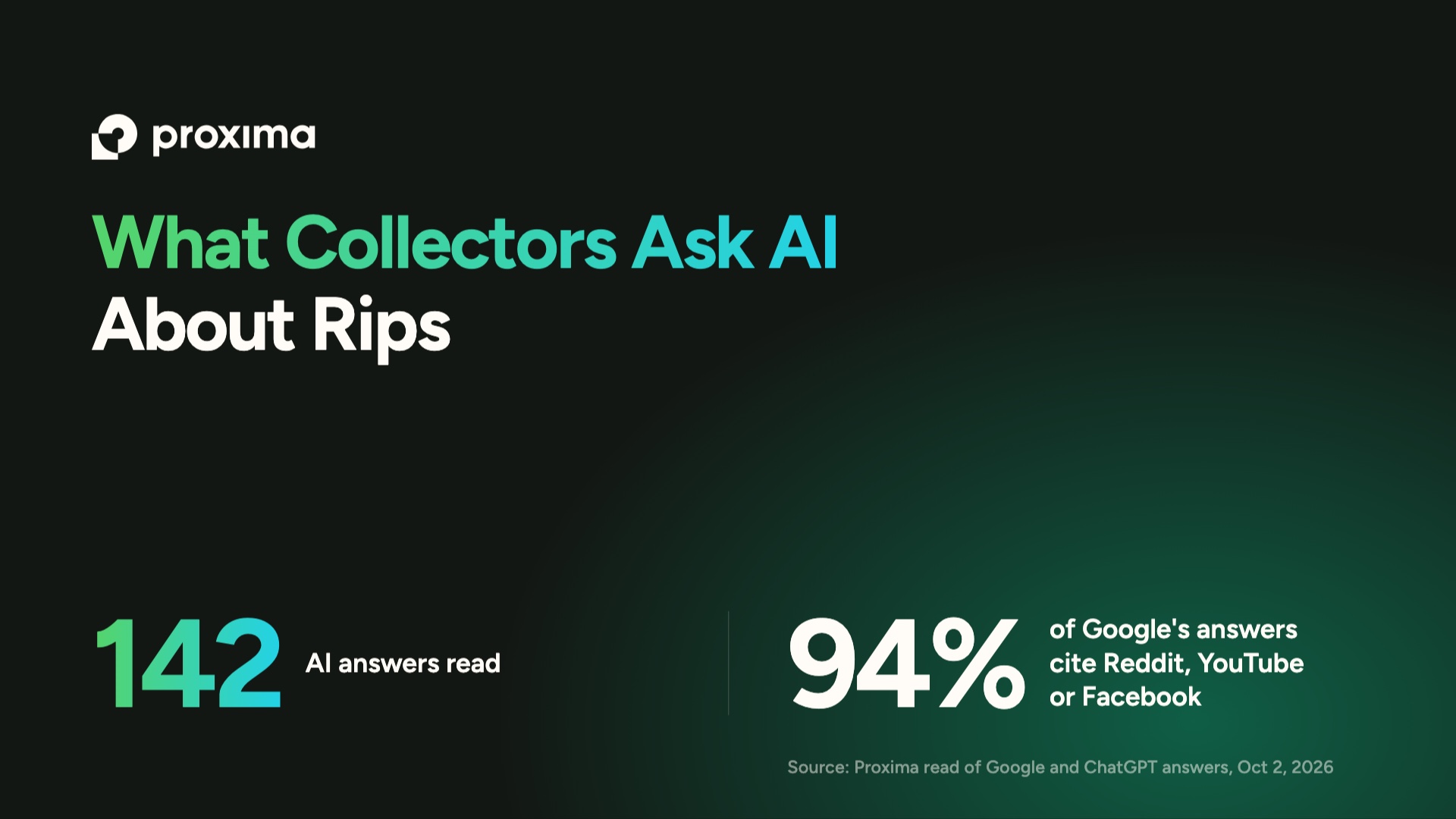
Neither is free to write. Naming a price source can show your margin, and your supplier may have a say. But the audience asking is bigger than the forums. In the US, about 22,000 Google searches a month ask whether a rip app is legit. When we checked in October, most of the AI and search answers came from Reddit, YouTube and review sites, not from the apps.
THIS WEEK
- Search "is [your app] legit". Note whose page answers.
- Look your app up on PackScout. Note what it rates you on.
- Draft the two sentences: your price source and how often it updates, and where the cards are held and what shipping one costs and takes. If your packs come from a supplier, ask them the same two questions.
- Send the draft to whoever signs off your terms page.
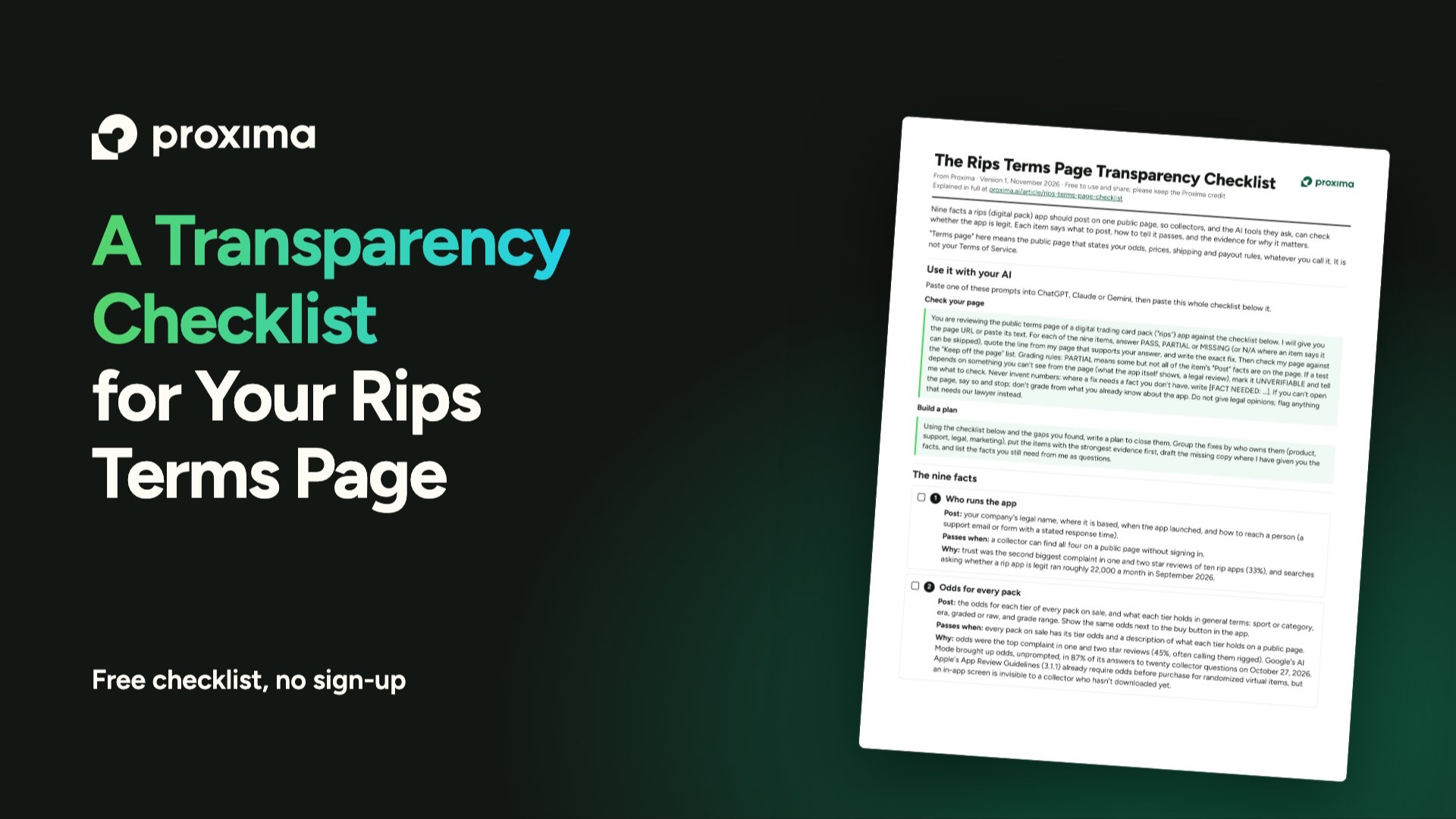
We listed every fact we'd consider posting, with a test for each, in our terms page checklist.
3. Collectors are counting who gets paid
The marketing is getting its own coverage. SBC Americas reports that smaller platforms advertise on social media with celebrities and athletes.
Collectors notice. In the most discussed forum thread on rip apps, the replies single out influencer deals.
They have little to go on. Of the 15 most watched videos we checked, one carried YouTube's paid promotion label. Three carried an app's promo or referral code in the description.
Our take. We'd rather a collector be told a video was paid for than work it out.
When a review and a placement look the same, every good review gets discounted. That includes the ones you never paid for.
That doesn't mean publishing your creator list. It means saying how you work with creators, and making sure the paid videos are labelled.
The same goes for the ad itself. Google bars claims that present "an improbable result (even if this result is possible) as the likely outcome." Microsoft's gambling policy says an ad can't show winning as the most probable outcome. TikTok bans guarantees of winning.
THIS WEEK
- Add one line to every creator brief: turn on the platform's paid promotion label.
- Write one public sentence on how you work with creators: that some are paid, and that paid videos are labelled.
- Take one of your top ads that leads with the rarest card. Run a version that leads with a typical pull against it. Judge it on the metric you already report.
4. One audit comes with a written rulebook
Every ad platform has written down how it reads a product like yours. That reading decides whether your ads run.
In August a hobby newsletter wrote that for three weeks every other ad in its Facebook and Instagram feeds was for a pack app. Both are Meta's, and every one of those ads was subject to its policy.
For most apps that is the first policy to read. It asks for authorization before an account advertises what it counts as gambling: a license, or proof the activity is "otherwise established as lawful." Digital packs aren't named in it. How it applies to them is Meta's decision.
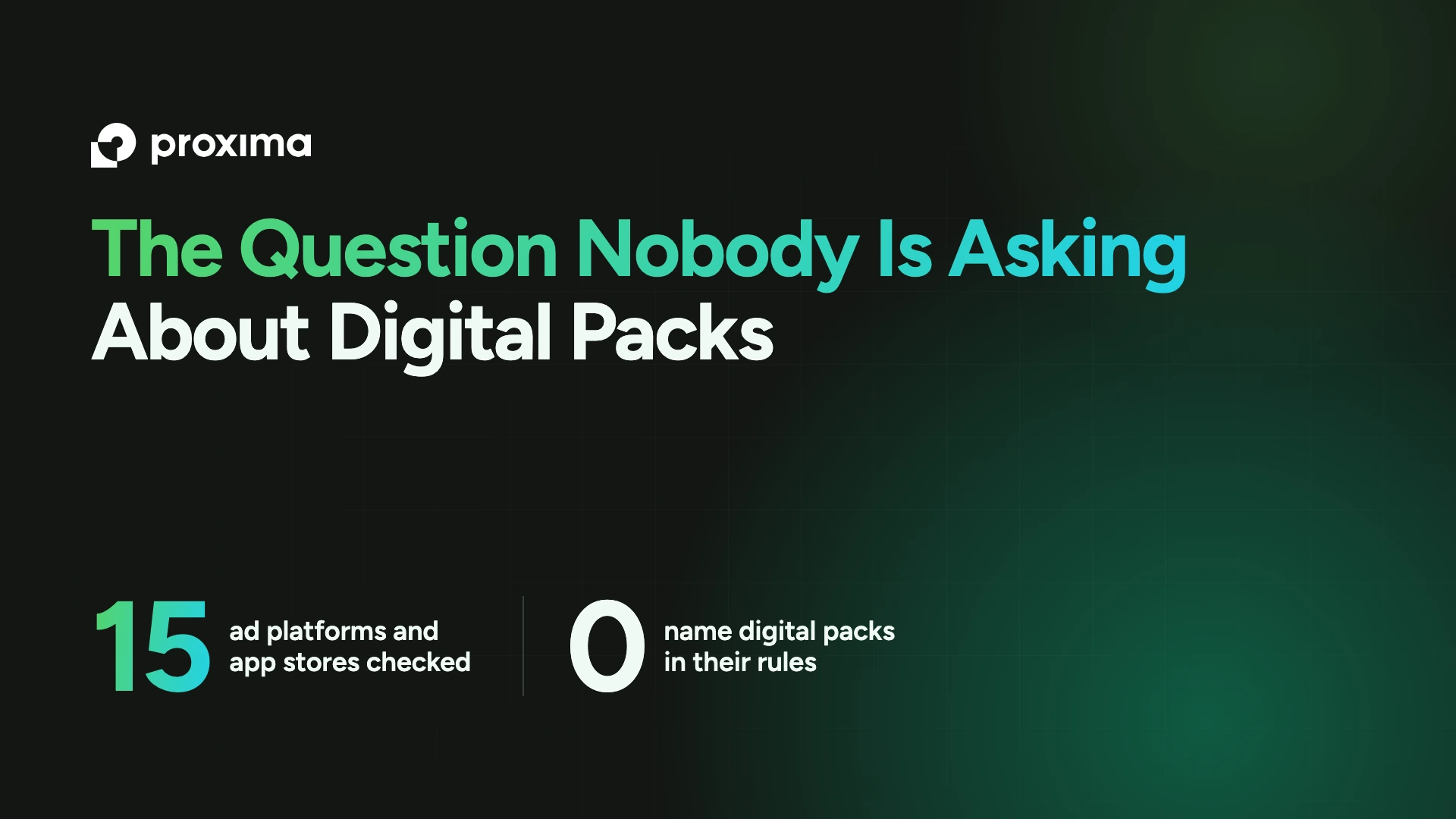
On November 10 and 11 we read all 15 policies from our September review again. Fourteen rows stand. One was wrong: we wrote that AppLovin publishes no criteria for gambling ads. It does. A page linked from its policy lists the minimums, including licenses, disclaimers and a problem-gambling hotline, and we've corrected the grid. Six of the pages have been revised since: TikTok Ads, TikTok Shop, AppLovin, Pinterest, Microsoft Advertising and Apple's App Store guidelines. None changed the passages that apply to packs.
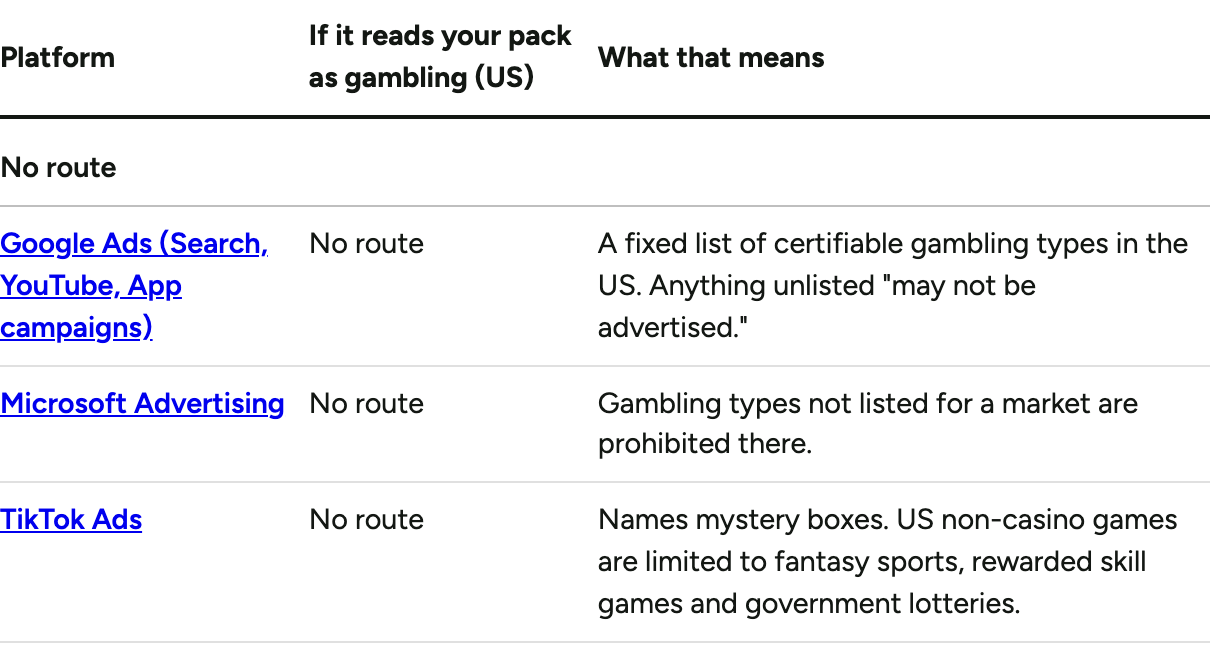
Meanwhile the press and the lawyers keep asking whether rips are gambling.
The newest reporting, from SBC Americas on November 6:
- Current and former regulators told the outlet they have not looked closely at rips. Their attention is on prediction markets.
- PrizePicks' chief legal officer said the company sent a 70-page legal analysis to state attorneys general before it launched packs.
Elsewhere, a New York bill on "instant payout loot boxes" sits in an Assembly committee. The lawsuits filed so far concern live card breaks, as ESPN reported in June.
The attention grows with the names. PrizePicks launched packs on October 21 in all 50 states. OG.com, a prediction market app, followed about eight days later. SBC Americas reports that FanDuel is "beginning to dabble."
Our take. Lawyers, regulators and courts will settle that question. Nothing we write will move it. The review you can prepare for today is the ad platforms'.
THIS WEEK
- List the platforms behind most of your installs.
- Find each one on our grid. Then open the policy page itself and read the passage the grid points to.
- Work out what share of your installs comes from your largest ad account. If that account paused tomorrow, know the first thing you'd do.
The short version
- Know what your packs pay before a creator tells you.
- Say whose prices you use and where the cards are held.
- Label what's paid.
- Read your platforms' rows in our ad policy grid.
About this series
This is Part 4 of our series on digital packs. Parts 1 to 3 cover how ad platforms read a pack, what collectors ask AI before they download, and what to post on your terms page.
How we made this
Written and edited by Proxima's team, with help from AI on research and drafting. Every figure is sourced below. View counts are as displayed on November 10, 2026.
Sources
- YouTube and X, view and subscriber counts as displayed on November 10, 2026. YouTube searches for about 40 rip apps, first page of results per app.
- Blockworks, Jake Koch-Gallup, "Who Is Winning the Onchain Gacha Trade," August 20, 2026.
- SBC Americas, Pat Evans, "Digital card rips launches by PrizePicks, OG.com push gaming deeper into murky space," November 6, 2026.
- New York Assembly Bill A9044-B, status as of November 12, 2026.
- ESPN, Dan Hajducky, "Could box breaking be considered gambling or a lottery?" June 20, 2026.
- cllct via Yahoo Sports, "The year in collectibles: Have repacks had a positive impact?" January 7, 2026.
- Womble Bond Dickinson, "Chase: Trading Card Repacks Face Growing Legal Scrutiny," August 5, 2026.
- Mantel, Mike Metzler, "Enter PackScout: Bringing Wall Street Analytics to Digital Repacks," October 13, 2026.
- Josh Luber and Jesse Einhorn, "The Blindboxification of Everything," February 2026.
- The Hobby Wire, "Buy the Pack. Sell it Back. Repeat." August 18, 2026.
- Proxima re-read of 15 ad-platform and app-store policies, November 10 and 11, 2026 (first reviewed September 23, 2026). Meta Transparency Center, Online Gambling and Games policy.
- Reddit, r/PokeInvesting and r/sportscards, search results and threads read November 10, 2026.
- Google Keyword Planner, monthly search volumes for September 2026, as published in Part 3 of this series. AI and search answers checked October 2 and October 27, 2026, as published in Part 2.

Ready to break through your performance ceiling?


