
What Collectors Ask AI About Rips
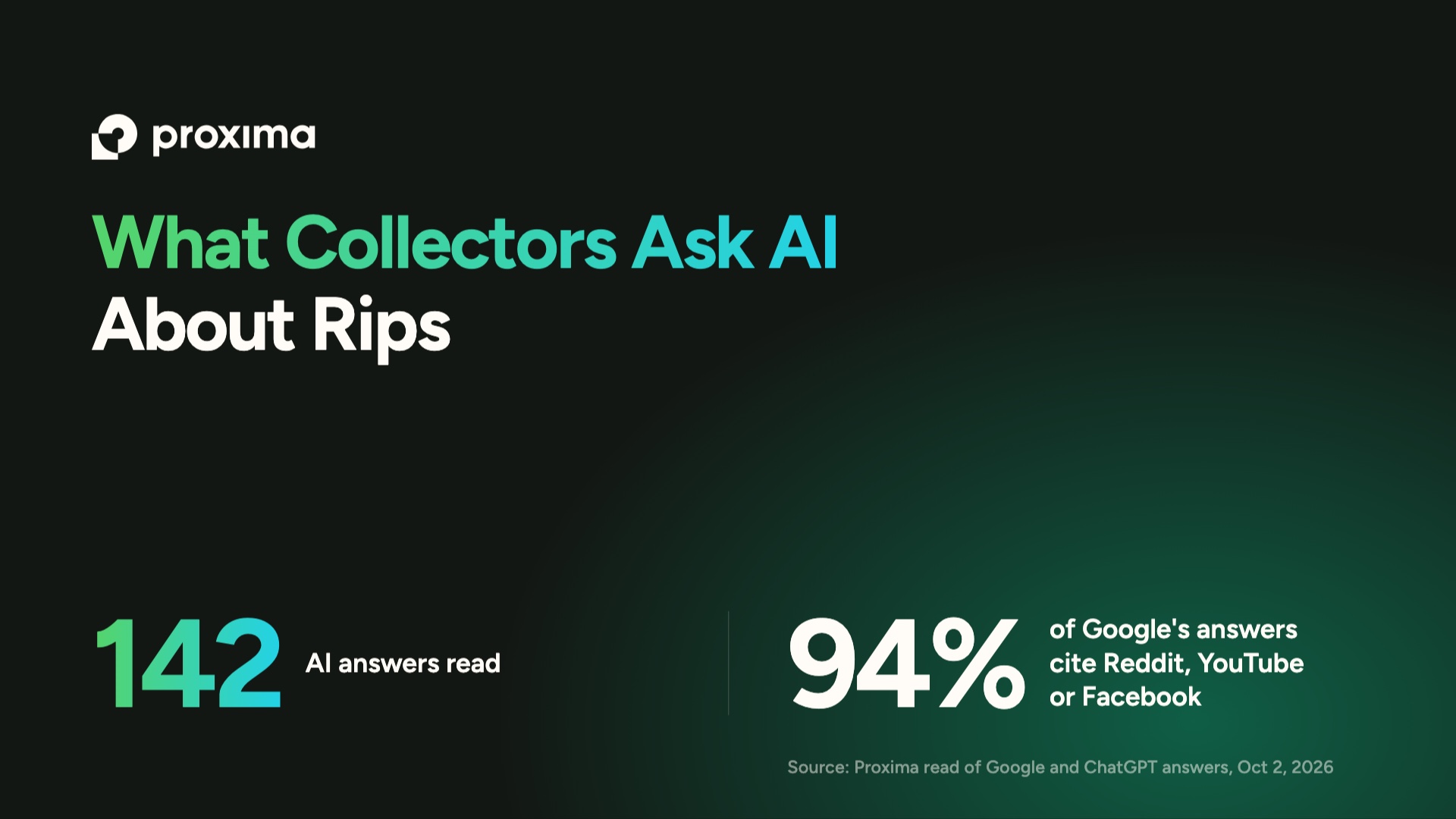
Before someone downloads your app, they ask Google or ChatGPT whether it is legit. Right now the answer comes from Reddit threads, YouTube videos and review sites run by sports betting and casino media, because too few apps have written the answer down themselves.
Here is what AI tells collectors today, and four moves to help make the answer come from you.
Part 2 of our digital packs series from Proxima, where we build ad audiences of buyers who actually convert, from real purchase data. Part 1 covered where packs stand with 15 ad platforms and app stores.
The last thing a collector reads before downloading is not your ad
Picture a collector watching a big pull in your ad. Before they tap download, they open Google and type something like "are card ripping apps legit?"
They're far from alone. Searches like "[app] legit" and "[app] reddit" rose about 550% in eleven months, from about 4,600 a month in October 2025 to about 30,000 in September 2026.
You paid for the impression, and the ad did its job. But the answer they read next decides whether they download, and right now most operators aren't shaping it.
We've spent hours talking strategy with rips operators, and this moment never came up. So we ran the process ourselves to see what collectors actually get back.
We started with that exact question. In early October, Google's AI Mode answered from Reddit threads, YouTube videos, an App Store listing, a WIRED article and a Deadspin review. We asked three times, and none of the pages it cited came from an app.
It framed rip apps as closer to gambling than to collecting, a framing that, fair or not, many collectors now read right after your ad. When we asked again on October 27, the framing hadn't moved. By then the only app page in the sources belonged to a daily fantasy company's pack product.
ChatGPT is the more encouraging story. In early October it leaned on App Store listings and casino review sites. By October 27 it leaned on the apps' own pages more than any other kind of source. When an app has written the answer down, AI tends to use it. That's your opening.
Collectors care more about who they can trust than who is best
It's easy to assume "best app" is the first thing people search. That's probably true when you're shopping for a new shampoo or a water bottle. Digital packs work differently.
Collectors search whether there's a promo code, whether the app works on their phone, whether it's legit and what Reddit says about it. Each of those draws more Google searches than "best app" does. Together they draw more than ten times as many, about 65,000 searches a month against about 5,000.
The biggest worry is trust. Searches about whether an app is legit and what Reddit says about it draw about 26,000 a month on their own. That's more than promo codes, and more than five times "best app."
App Store reviews point the same way. Across 2,576 recent reviews of ten rip apps, the top complaint in one and two star reviews was rigged odds. One of the most common compliments in four and five star reviews was simply that the card arrived.
That low bar points to some easy wins. Show that your odds are real and your price is fair, and that the card will ship and money can come back out. Right now, few apps answer that on a page of their own.
AI fills the gap with other people's pages
In early October 2026, we took twenty questions collectors actually type, word for word from Google's search suggestions, its "People also ask" boxes and Reddit thread titles. We asked each one three times on ChatGPT and on Google's AI Mode.
On October 27 we asked them all again. That gave us more than two hundred answers, each with the sources it drew on. The details moved within weeks, so take any single answer with a grain of salt, but the pattern held.
Google leaned on community posts from Reddit, YouTube and Facebook. Both tools cited an app's own site when it plainly answered the question.
The details move because these tools search the web fresh and write a new answer every time. Ask the same question twice and you often get a different list of apps. They misread names, too.
In our first read, we also asked a question that names an app, "where is rips by triumph legal." It's the kind of thing a collector types to check whether Rips by Triumph, one of the apps Google named most often, works in their state. Google answered from Triumph's own help pages and told the collector where the app is available. ChatGPT mistook it for an unrelated local business.
When we asked ChatGPT again on October 27, it recognized the app and answered from the same Triumph help pages. In both high quality answers, the source was a page Triumph wrote.
The AI is building a comparison chart, and your row is blank
None of our questions asked about shipping, yet Google brought it up in nearly every answer, along with pack prices, odds and buyback offers. Collectors type short questions, and the AI decides on its own what a good answer has to cover.
Asked for the best app to rip cards, Google built its own table comparing apps on starting price, buyback rate and standout feature. It pulled the figures from App Store listings, a sports news article and Reddit.
When we asked again on October 27, Google built the table again, and four of the five apps in it had changed. In between, two "best rip apps" roundups, one of them on a sports betting site, had become two of the pages Google cited most, and the new names were their top picks.
We ran the second read signed out of Google, which can shift results. But neither roundup appeared anywhere in our first read.
| App | Starting price | Buyback rate | Standout feature |
|---|---|---|---|
| App A | from its App Store listing | from a Reddit thread | from a sports news article |
| App B | from its App Store listing | from a Reddit thread | from its own site |
| App C | from a sports news article | from a Reddit thread | from its App Store listing |
| Your app | ? | ? | ? |
The kind of comparison Google built when we asked for the best app to rip cards, with app names removed. Each cell shows where a figure like it came from. Source: Proxima AI-answer read, October 2, 2026.
So the questions you need to answer include the ones the AI adds on the collector's behalf. Your app gets a row in that chart whether you publish anything or not.
If your shipping times, buyback terms and odds sit on a page the AI can read, it copies them. If they don't, it fills the cell from whatever else it finds, like a Reddit thread or a betting site's review. In our first read, the apps credited with "transparent published odds" were the ones that had published them on their own site.
Some numbers are worth keeping back, though. Your buyback spread is your margin, and posting the exact rate invites a price comparison. Collectors mostly need proof that money comes back out, and you can show that without the rate.
What helps, and what you can skip
Most of the advice for sale about AI search is untested. A few things have real evidence behind them.
Make sure AI can read your site. Some sites block the tools ChatGPT and others use to read the web. OpenAI says sites that block its search crawler won't appear in ChatGPT's search answers, so ask whoever runs your site to check.
Get your facts onto the sites AI quotes. A University of Toronto study found that roughly three in four sources cited in consumer "best X" answers were sites the brand didn't own, like review sites and forums.
You can't write those pages, but you can make sure what they say about you is current and correct. They often copy their facts from your own pages anyway. In our second read, a sports betting site's roundup repeated Triumph's own line about where the app is available, and Google quoted the roundup.
Back each answer with numbers and sources. In controlled tests, Princeton researchers found that pages with real statistics, quotes and cited sources were more likely to be used in AI answers. Write each page to answer one question up front, in the words collectors use.
Two popular fixes don't help. Adding "schema," code that labels your pages for search engines, earned no extra AI citations in an Ahrefs study of about 1,900 pages. An "llms.txt" file, meant to talk directly to AI, showed no link to citations in an SE Ranking study of about 300,000 sites.
Where to start
Here's where we'd start, in order.
1. Publish one terms page, and make it easy to find. Cover what a collector pays and what they can pull, then how the card reaches them and how money comes back out.
For buyback, your typical time from sell-back to payout, or the minimum you'll always pay, proves the point without publishing your spread. Add the states you operate in and the date you last checked.
Link it from your homepage, your App Store description and your help center, and make sure it opens without a login. Clear odds and state availability with counsel first; the AI will quote somebody's version either way.
2. Find your trust questions, then give each one its own page. Type your app's name into Google and note what it suggests, like "legit," "promo code," "reddit" or "scam," then check the "People also ask" box below the results.
If you run Google Ads, its free Keyword Planner shows how many people search each one a month. Give the biggest questions their own pages, starting with your promo code and where the app is available. On the page about whether you're legit, show a dated example of a card shipping and a withdrawal landing.
3. Show up where collectors talk. Keep your App Store listing current and reply to reviews, since listings are one of the sources ChatGPT cites most.
Check that rip tracker sites like PackSpy and RipCompass, and the "best rip apps" roundups AI quotes, have your details right. On Reddit and YouTube, have a real person from your company answer under their own name.
4. Check what AI says about you every month. Ask ten collector questions on ChatGPT and Google, and note whether you were named and which sources showed up.
Answers change from one try to the next, so watch the trend over months. Between our two reads, 25 days apart, Google's top pick for "what is the best app to rip cards" changed. Ten questions to start with are listed in the sources below.
The answer should come from you
Collectors will keep asking AI whether your app is legit, and the AI will keep answering from whatever pages exist.
Start with the terms page, since it answers the trust question every other page builds on. If you only have an afternoon, your promo code page is the quick win. Our next piece is a checklist for the terms page.
How we made this. Written and edited by Proxima's team, with help from AI on research and drafting. Every figure is sourced below.
Sources
- Google Keyword Planner through the Google Ads API: US, English, Google Search only, 1,786 in-scope phrasings grouped by intent. Monthly volumes for August 2026, pulled October 12, 2026. The growth figure counts searches that pair a rip app's name (Rips by Triumph, Arena Club, Packz, Courtyard and others) with a trust word such as "legit," "scam," "worth it," "reddit" or "reviews," October 2025 against September 2026, pulled October 27, 2026. Proxima analysis.
- Google autocomplete and People Also Ask, US, October 2 and October 27, 2026. Ten questions to start with, word for word: "what is the best app to rip cards," "what is the best app for ripping Pokémon cards," "what is the best app to rip sports cards," "what are the best card rip sites," "best card rip apps reddit," "are card ripping apps legit," "how do digital card packs work," "are digital packs worth it," "what are card rips," "are card rip apps worth it."
- Apple App Store, most recent US reviews for ten rip apps, March 27 to October 1, 2026, 2,576 reviews, themes tagged by keyword. Proxima analysis, October 2, 2026.
- Proxima AI-answer read: 20 unbranded collector questions taken from Google autocomplete, People Also Ask and Reddit thread titles, three runs each on ChatGPT (logged out, web search on) and Google AI Mode: 114 answers on October 2, 2026 (Google signed in) and 120 on October 27, 2026 (both engines logged out). Plus 14 branded and policy questions on both dates, for 142 and 148 answers in all.
- OpenAI, "Overview of OpenAI crawlers." https://developers.openai.com/docs/bots
- Chen, Wang, Chen and Koudas, "Generative Engine Optimization: How to Dominate AI Search," University of Toronto, arXiv 2509.08919, September 2025. https://arxiv.org/abs/2509.08919
- Aggarwal et al., "GEO: Generative Engine Optimization," KDD 2024, arXiv 2311.09735. https://arxiv.org/abs/2311.09735
- Ahrefs, schema markup and AI citations, 1,885 pages against matched controls, May 11, 2026. https://ahrefs.com/blog/schema-ai-citations/
- SE Ranking, llms.txt study of about 300,000 domains, November 7, 2025. https://seranking.com/blog/llms-txt/

Ready to break through your performance ceiling?


